

Most systems that matter are still invisible until they break, and immigration is one of them.
It governs where people can live, work, and build their lives. Yet across Asia-Pacific, it remains fragmented, inconsistent, and largely manual. The rules exist, but they are not organized in a way that users can reliably act on. As a result, outcomes depend less on eligibility and more on execution.
Issa Compass is building the missing layer: a system that turns immigration into something legible.
But what makes this particularly compelling isn’t just the product. It’s the timing, the founders, and the sheer size of the problem they’re going after.
A Coordination Problem Disguised as Complexity
From the outside, immigration appears complicated. In practice, much of the difficulty comes from coordination failure.
Applicants don’t know which visa they qualify for. Requirements vary across sources. Small errors lead to rejection. Agencies fill the gap, but often operate with limited transparency and inconsistent quality.
The system produces friction not because it is inherently unknowable, but because it has never been structured end-to-end.
This is the kind of problem that tends to persist for decades – until someone treats it as infrastructure.
Structuring the Process
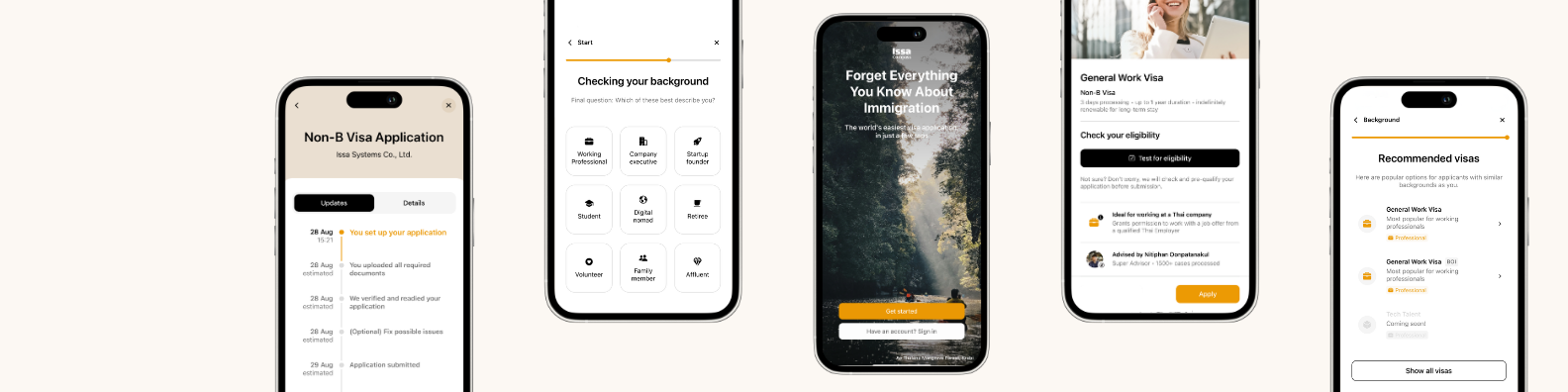
Issa Compass approaches immigration as a sequence of decisions, not a collection of documents.
Users answer a small set of questions. The platform determines eligibility, maps out the process, and enforces order: what needs to be done, in what sequence, and by when.
Documents are validated before submission. Forms are generated programmatically. Edge cases - typically handled through experience and guesswork - are informed by prior application data.
The result is a process that behaves more like software than paperwork.
Efficiency is a byproduct. In one case, a 5-year visa was approved in under 12 hours. More important is consistency: reducing variance in outcomes for users who are already eligible.
Why This Moment Exists
Two shifts are converging.
- Mobility has increased. Remote work and global talent flows have expanded the number of people navigating cross-border systems.
- Governments are adapting. New visa categories are emerging as countries compete for skilled workers and long-term residents.
What has not changed is the interface.
At the same time, advances in AI and document processing make it possible to formalize workflows that were previously informal. This creates an opening to rebuild the system around the user.
Traction That Matters
Early-stage companies often talk about potential. What impressed us here was Issa Compass's execution.
- Reached $1M ARR within 5 months
- 10,000+ inbound users per month
- 99% approval rate for pre-qualified applications
- Supporting teams from companies like Google, Meta, and Wonderfruit
- Maintaining a 4.8/5 user rating on Google Reviews
These metrics suggest a simple pattern: when the process becomes clear, users follow through.
A Larger Surface Area
Visas are the entry point. Once a user is in the system, adjacent needs follow: renewals, tax compliance, insurance, housing, banking, employer support. Each layer compounds the relationship.
In Thailand alone, 1 to 2 million long-term foreign residents require ongoing compliance. With an estimated ~$2,000 lifetime value per user, the market is already significant. Across APAC, it expands by an order of magnitude.
What matters is not just the size of the market, but its structure: recurring, regulated, and operationally complex – conditions that favor systems over services.
Meet The Founders

Issa Compass is led by Priscilla Yeung and Aaron Yip.
Priscilla brings structured thinking and operating discipline. At Boston Consulting Group, she worked across markets, learning how to break down complex systems into something executable. At foodpanda, working closely with the CEO on APAC strategy, she saw how large-scale operations actually run. She tends to default toward clarity, accountability, and getting the details right - traits that matter in a process where small mistakes have real consequences.
Aaron complements this as a builder at heart. He has spent years working close to the technical edge across computer vision, generative systems, and large-scale software. Before Issa, he led work at Y Combinator New Cities and later advised startups as an Iterative Visiting Partner. He moves quickly to first principles and tends to see what can be automated or removed entirely.
More importantly, both have direct exposure to the problem. Aaron grew up in an immigrant family, where opportunity was shaped by systems that were difficult to navigate. Priscilla has gone through visa processes herself, experiencing firsthand how unclear and unforgiving they can be.
That context shows up directly in the product – and is a large part of why we believe in their founder–problem fit.
Issa Compass: Visa in One App
Most people accept immigration as something that is slow, uncertain, and difficult to navigate. That assumption has gone largely unchallenged.
Systems like this tend to follow a predictable path. They begin by reducing friction. Over time, they become the default interface. If Issa Compass continues to execute, it will become the layer through which individuals and companies interact with immigration systems across the region. That position compounds.
Issa Compass is built on the belief that this process can be made clear and reliable.
We think that belief is right.
![Iterative Scale Program [Closed]](https://cdn.prod.website-files.com/60b1bd0542d31f694712f8ec/6ab64c6dc500d0e0141edd37_6ab64bc604a4d8df105975f2_neom-85ey1vFIwkc-unsplash.webp)


